
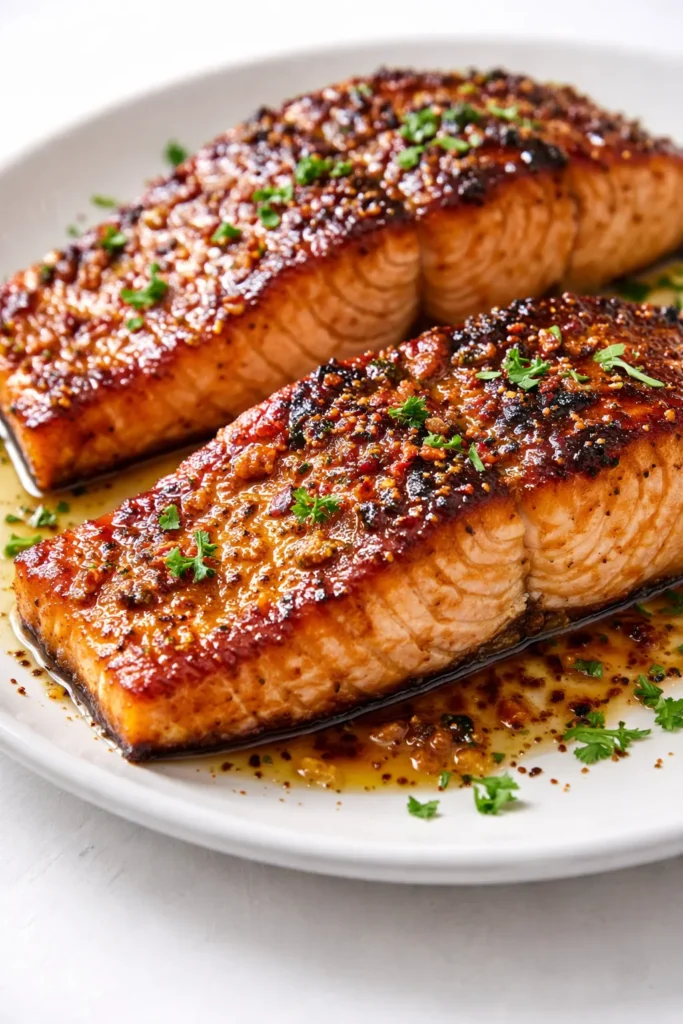
I’ve lost count of how many salmon recipes I’ve tried that promised restaurant-quality but delivered dry, flavorless fish. This one? It’s the closest I’ve come to that Texas Roadhouse experience at home — and it takes less time than it would to drive there.
The short version: A buttery, slightly spicy glaze that caramelizes on top while the salmon stays tender and flaky inside. Twenty-five minutes, start to finish.
My husband, who claims he doesn’t like salmon, ate two servings. That’s my benchmark.
- Serves: 4 as a main
- Hands-On Time: 10 min | Total Time: 25 min
- Difficulty: Easy weeknight win — one pan, no fuss
- Cost per serving: ~$4
- Calories: ~350 per serving
- Dietary Notes: Naturally gluten-free if you use tamari. Easily made dairy-free.
(Photo above: overhead shot of two salmon fillets on a dark slate plate, glaze glistening, a sprinkle of green onions and sesame seeds, natural light from a side window showing the caramelized edges and flakes beginning to separate.)
The Secret to That Sticky-Sweet Crust (Without the Sugary Burn)
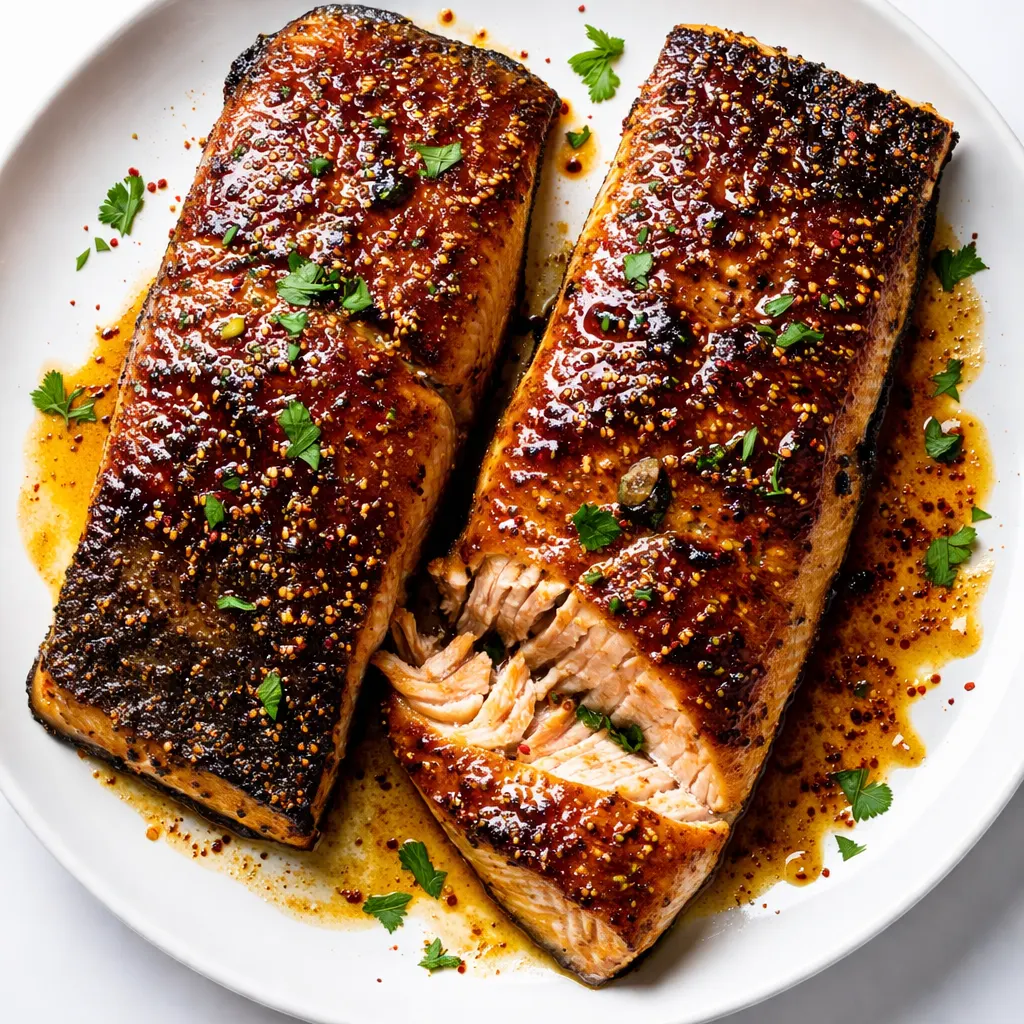
Most glazed salmon recipes end up with a burnt sugar crust or a pool of liquid at the bottom of the pan. The trick here is a two-step process: bake the salmon covered with half the glaze first, then brush on the rest and finish under the broiler. That second layer caramelizes into a glossy shell while the inside stays perfectly tender. No bitter char, no sad puddle.
The glaze itself walks that line between sweet, savory, and just warm — brown sugar gives it that Roadhouse stickiness, butter adds richness, and a tiny hit of cayenne makes the whole thing interesting without overwhelming anyone.
I buy skin-on fillets because they’re cheaper and the skin gets crispy in the oven — my kids literally argue over the crispy bits.
Ingredients Worth Talking About
- 4 salmon fillets (6 oz each), skin on or off: Skin-on holds up better to the high heat. If you prefer skinless, reduce baking time by a minute or two. Costco has the best deal per pound in my area, but I’ve also used frozen from Trader Joe’s — just thaw completely first.
- 3 tablespoons brown sugar, packed: Light or dark works. Dark gives a deeper molasses note that I love. I’ve made this with coconut sugar for a slightly less sweet version — it still caramelizes beautifully.
- 2 tablespoons unsalted butter, melted: For richness. Use salted butter and skip the flaky salt at the end if that’s what you have. My dairy-free version uses avocado oil and a splash of coconut cream — different but still good.
- 2 tablespoons low-sodium soy sauce (or tamari for GF): The salty umami that balances the sugar. My kids can smell the difference when I use full-sodium soy sauce — it’s a little too salty for them. Low-sodium is perfect.
- 1 tablespoon Dijon mustard: Don’t skip it — it emulsifies the glaze and adds a subtle tang. I’ve used whole grain mustard too and loved the little seeds.
- ½ teaspoon garlic powder: Not fresh garlic — it burns under the broiler. Learned that one the hard way.
- ¼ teaspoon cayenne pepper: Adjust to your heat tolerance. I use a heaping ¼ for “adult” batches and a pinch for kid batches. My youngest calls it “spicy honey fish” and eats it without complaint.
- Flaky salt and fresh pepper: For finishing. Don’t skip the flaky salt — it gives a little crunch and brightens the whole dish.
- Optional garnishes: Sliced green onions, toasted sesame seeds, lemon wedges. I do green onions every time — they add color and a fresh bite that cuts through the richness.
What to Pull Out Before You Start
- Rimmed baking sheet — I use a half-sheet pan, but any oven-safe dish works. Just line it with foil or parchment for stupid-easy cleanup.
- Small bowl and whisk for the glaze.
- Pastry brush or spoon for glazing.
The only critical thing: line your pan. The sugar in the glaze will stick like cement. Foil saves you a lot of scrubbing.
Making This Salmon: My Exact Process
Everything happens on one sheet pan. Read through once — most of these are 60-second tasks.
Preheat and prep: Heat your oven to 400°F with a rack in the upper third. Line a rimmed baking sheet with foil or parchment (foil is easier for clean-up).
- Mix the glaze: In a small bowl, combine the brown sugar, melted butter, soy sauce, Dijon, garlic powder, and cayenne. Whisk until smooth — it’ll look like a thin caramel sauce. Don’t worry if it separates a little; just whisk again right before brushing.
- Prep the salmon: Pat the fillets dry with paper towels (this is non-negotiable for a good sear). Place them skin-side down on the prepared baking sheet, spaced at least an inch apart. Sprinkle very lightly with salt. (📸 Photo tip: The fillets should look dry and matte, not wet. Pat them until the paper towel comes away clean.)
- First glaze: Brush about half the glaze evenly over the tops and sides of the fillets. Reserve the remaining glaze. You want a thick, even coating — don’t pour it on, brush it on so it sticks.
- Bake: Bake for 12–14 minutes, until the salmon is just opaque around the edges and the center is still a little translucent (it’ll finish cooking under the broiler). Set a timer. Overcooked salmon is the saddest salmon.
- Broil: Switch the oven to broil (high). Carefully brush the remaining glaze onto the fillets. Broil for 2–3 minutes, watching closely, until the glaze is bubbly and browned at the edges. (📸 Photo tip: The glaze should be bubbling actively, and the edges of the fillets will be a deep golden brown. Don’t walk away — it goes from perfect to burnt in about 45 seconds.)
- Rest and garnish: Remove from the oven and let the salmon rest on the pan for 5 minutes. Sprinkle with flaky salt, green onions, and sesame seeds if using. The residual heat will carry the salmon to perfect doneness.
On a tired weeknight, I skip the broiler step and just bake an extra 2 minutes. It’s not as pretty, but it’s still delicious. My kids prefer it that way, actually — they say the glaze is “less sticky.” More for me.
How I Meal Prep This for the Week
I wish I could tell you this salmon reheats perfectly, but it’s best fresh. What I do instead: make two batches of the glaze on Sunday (it keeps in the fridge for a week), portion my fillets, and cook them fresh on busy nights. Five minutes of prep the morning of, and dinner’s on the table in 25 minutes flat.
- Fridge: Store cooked leftovers in an airtight container for up to 3 days. The glaze softens but the flavor stays.
- Freezer: Not recommended — the texture of thawed cooked salmon gets mealy.
- Reheat: The oven at 300°F for 5–7 minutes (loosely covered) is your best bet. Microwaving turns it into a sad, fishy hockey puck. Trust me on this one.
Things I Wish I’d Known the First Time
- Your salmon’s thickness affects the timing. A thick center-cut fillet needs closer to 14 minutes; a thin tail piece might be done in 10. Check at the minimum time and go from there. Even if you mess this up a little, it’ll still taste good — I’ve done it. Twice.
- Don’t skip the foil. The sugar in the glaze will weld itself to your pan. Foil turns cleanup into a two-second peel.
- Let the salmon rest. I know you’re hungry. But that 5-minute rest is what lets the juices redistribute. Cut into it too early and all that beautiful moisture runs onto the plate.
- Broiler distance matters. If your broiler is super close (like mine), drop the rack one level lower or reduce time to 1–2 minutes. If it’s far, you might need 4 minutes. Watch it — learn your oven’s personality.
- Double the glaze if you like it saucy. I sometimes make 1.5x the glaze recipe and brush a little extra on after broiling for a glossy finish. My husband calls it “the extra sauce life.”
Swaps That Actually Work
- Dairy-Free: Use melted coconut oil or avocado oil in place of the butter. For extra richness, add a tablespoon of full-fat coconut cream. My sister-in-law is dairy-free and this is the version I make for her — she never complains.
- Spicy (Adults-Only Version): Double the cayenne and add a pinch of red pepper flakes to the glaze. Broil as directed. I do this when it’s just me and my husband — we eat it with rice and a cold beer.
- Kid-Friendly (No Heat): Omit the cayenne entirely. Add an extra teaspoon of brown sugar or a splash of honey. My pickiest eater calls this “the fish that tastes like candy.” I’ll take it.
- No Brown Sugar? Use maple syrup or honey. Reduce the amount to 2 tablespoons (they’re sweeter). Watch the broil more closely — honey browns faster. I’ve done it with maple in a pinch and it was honestly delightful.
- Need to feed a crowd? This scales beautifully. Make 1.5x the glaze for 6 fillets, 2x for 8. Just don’t crowd the pan — use two sheets if needed.
Questions I Get About This Salmon All the Time
Q: Why did my glaze burn under the broiler?
A: Ugh, I’ve been there. It’s usually one of two things: your broiler is too close, or you left it in too long. Next time, move the rack down one level and check at the 2-minute mark. Also, make sure you’re using low-sodium soy sauce — regular soy sauce can contribute to burning.
Q: Can I use frozen salmon?
A: Yes, but thaw it completely in the fridge overnight first. Pat it super dry before glazing — frozen fish holds more water, and that extra moisture will steam the glaze instead of caramelizing it. Not the end of the world, but not as sticky-good.
Q: How long does leftover cooked salmon keep?
A: In the fridge, tightly wrapped, up to 3 days. Best reheated in a low oven (300°F, 5-7 minutes, foil tented). The microwave will make it sad. I usually flake leftovers into a salad or mix with rice and a fried egg for a quick lunch the next day. Way better than nuking it whole.
Q: What do you serve with this?
A: Three things I rotate: (1) Simple roasted asparagus or green beans — toss them on the same sheet pan during the last 8 minutes of baking. (2) Rice or quinoa to soak up any extra glaze. (3) A crunchy coleslaw or cucumber salad for contrast. My kids love it with buttered noodles, which is decidedly not fancy but makes them happy.
More Recipes My Family Makes on Repeat
If you liked this one, here are a few others that get the same reaction at our table:
- Crunchy Cucumber Carrot Salad — The perfect side for this salmon, done in under 10 minutes.
- Twice Baked Breakfast Potatoes — A cold side that pairs beautifully with the warm, sticky fish.
- Baked Ranch Chicken — Same sticky-sweet vibe, but with chicken for the nights you want something different.
I’ve made this salmon so many times that I can almost taste it from memory — that first moment when the glaze hits your tongue, sweet then savory then just a tiny buzz of heat. I hope it becomes a regular in your kitchen too.
If you try it, drop a comment below — I love hearing how it goes for your family. Tag me on Pinterest or Instagram so I can see yours!
📌 Save this Texas Roadhouse salmon recipe for your next weeknight dinner that feels like a night out — it’s the family-friendly dinner win you’ll come back to again and again.
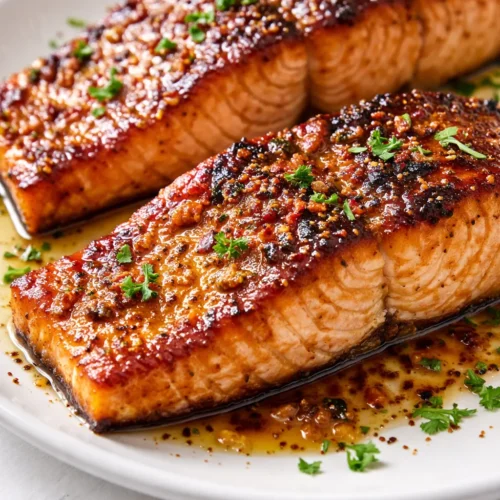
Texas Roadhouse Style Baked Salmon with Sweet and Savory Glaze
Equipment
- Rimmed baking sheet (half-sheet pan)
- Foil or parchment paper
- Small Bowl
- Whisk
- Pastry brush or spoon
Ingredients
For the Salmon Fillets
- 4 salmon fillets (6 oz each), skin on or off
For the Glaze
- 3 tbsp brown sugar, packed
- 2 tbsp unsalted butter, melted
- 2 tbsp low-sodium soy sauce (or tamari for GF)
- 1 tbsp Dijon mustard
- ½ tsp garlic powder
- ¼ tsp cayenne pepper (adjust to taste)
For Finishing
- Flaky salt and fresh pepper to taste
Optional Garnishes
- Sliced green onions
- Toasted sesame seeds
- Lemon wedges
Instructions
- Preheat the oven to 400°F with a rack in the upper third. Line a rimmed baking sheet with foil or parchment.
- In a small bowl, combine the brown sugar, melted butter, soy sauce, Dijon, garlic powder, and cayenne. Whisk until smooth — it’ll look like a thin caramel sauce.
- Pat the salmon fillets dry with paper towels (this is non-negotiable for a good sear). Place them skin-side down on the prepared baking sheet, spaced at least an inch apart. Sprinkle very lightly with salt.
- Brush about half the glaze evenly over the tops and sides of the fillets. Reserve the remaining glaze.
- Bake for 12–14 minutes, until the salmon is just opaque around the edges and the center is still a little translucent (it’ll finish cooking under the broiler).
- Switch the oven to broil (high). Carefully brush the remaining glaze onto the fillets. Broil for 2–3 minutes, watching closely, until the glaze is bubbly and browned at the edges.
- Remove from the oven and let the salmon rest on the pan for 5 minutes. Sprinkle with flaky salt, green onions, and sesame seeds if using. Serve with lemon wedges if desired.
Notes
Related Recipes:
 Cheesy Hamburger Casserole Bake That’s Ready in 40 Minutes (No Canned Soup Here)
 Lemon Capellini Salad for Late Summer Evenings: Bright, Tangy, Ready in 20 Minutes
 Creamed Cabbage and Ground Beef Casserole That’s Rich, Tender, and Done in 45 Minutes
 Creamy Garlic Tagliatelle That Looks Like a Restaurant Dish in 20 Minutes
 The Creamy Green Sauce Pasta That Looks Like You Made It for Instagram (But Tastes Even Better)
 Cucumber Shrimp Salad That Doesn’t Get Soggy — Finally