
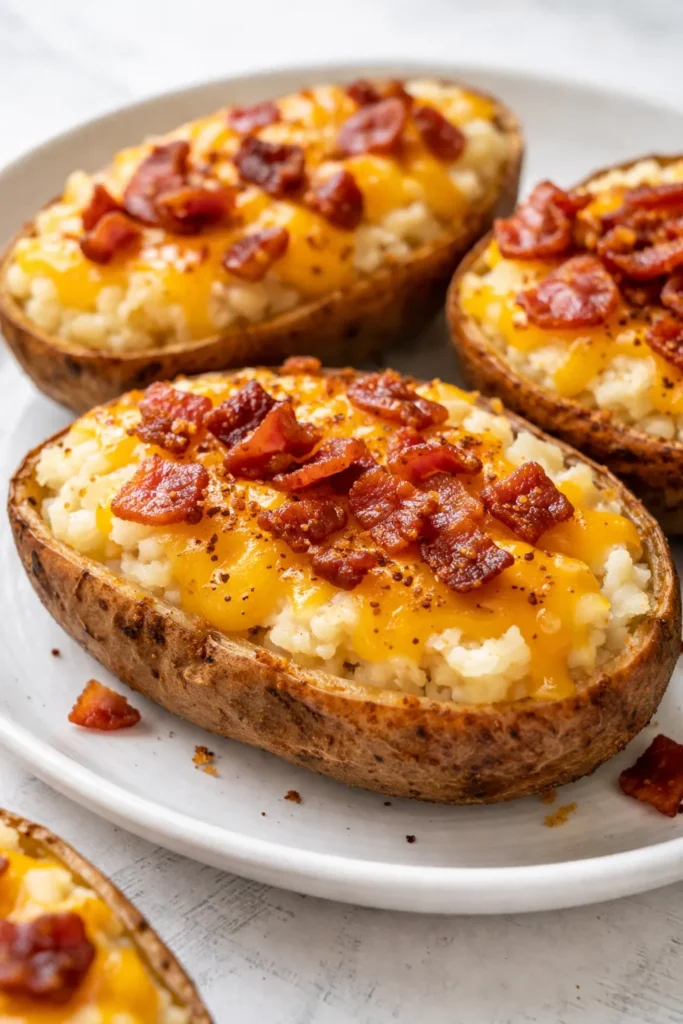
Shatteringly crisp skin, a molten cheese pull that stretches a full four inches, and a yolk that runs on command. I developed this version of twice baked breakfast potatoes for the kind of morning where the only plan is a second cup of coffee and a stretched-out hour at the table. No rushing. No complicated techniques. Just a plate that looks like you spent the whole morning on it — when really, the oven did most of the work.
The short version: Twice baked breakfast potatoes that are all reward, zero stress, and genuinely better than any brunch spot version I’ve tried.
I made about forty versions of this before I landed on this exact ratio. This one gets the text requests from friends the night before a weekend gathering. That is my metric for a keeper.
- Serves: 4 as a main, 6 as a side
- Hands-On Time: 20 min | Total Time: 1 hr 15 min
- Difficulty: Easy — the only hard part is waiting for the first bake
- Cost per serving: ~$3.50
- Calories: ~415 per serving (as a main)
- Dietary Notes: Gluten-free naturally. Easily made vegetarian.
(Photo above: overhead shot of two halved potatoes on a slate board, one cut open to reveal the creamy filling and a perfectly jammy egg, chives scattered strategically, steam still rising.)
The Fix for Every Potato Problem You’ve Had
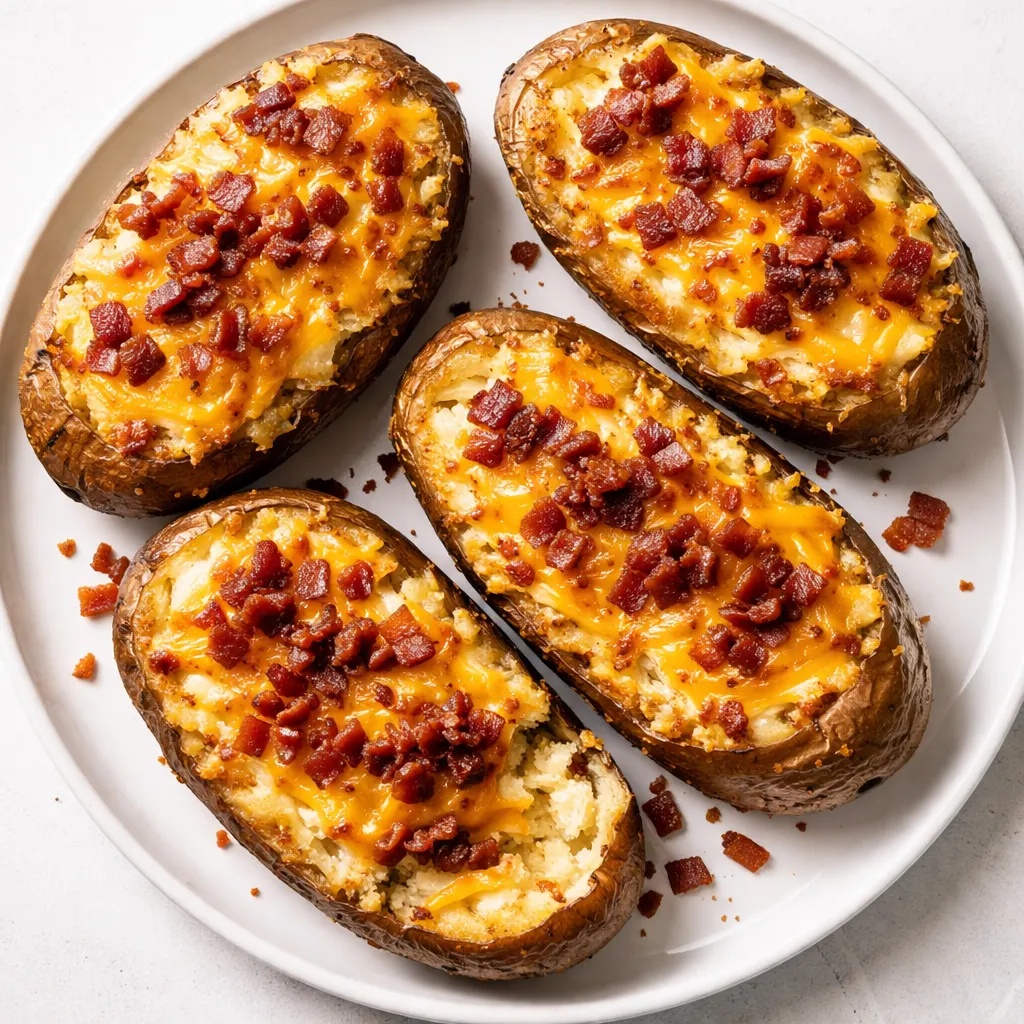
An oil massage. It sounds ridiculous. It is the only thing standing between you and a skin that shatters instead of chews. Most people spritz their potatoes before baking. That is not enough. You need enough oil to soak into the skin and streamline it, so the heat can do its crispifying job without resistance. Think deep rub, not light mist.
The filling is the other trap. Heavy cream makes it soupy. Sour cream turns it tangy in a way that fights the egg. Cream cheese and sharp cheddar are the answer. The cream cheese holds the structure, the cheddar brings the flavor, and together they create a base that is scoopable, not liquid. When you add the egg on top, it rests on a stable surface rather than drowning in a puddle.
You get a crisp shell, a velvety interior, and a runny yolk. Three distinct textures in one forkful. That is the entire point of a twice baked breakfast potato, and most versions fail at at least one of them. This one delivers all three.
Ingredients Worth Calling Out (And One That Isn’t)
- 4 large russet potatoes: Yukons are waxy and reds are too dense. You need the high starch content of a russet for a fluffy interior and a thick skin that holds up to the second bake. I have tried every potato in the bin. This is the only one that works consistently.
- 6 strips thick-cut bacon: Thin bacon disappears into the filling and turns into an oily shadow of itself. Thick-cut pieces assert themselves — they stay visible, they stay chewy, and they make the potato taste like breakfast. Reserve a teaspoon of the fat for the filling. You will thank me.
- 4 oz cream cheese, softened: Full-fat only. Low-fat cream cheese breaks when it hits high heat and leaves you with a grainy texture. The fat is what makes it smooth. Set it out ten minutes before you start.
- 1 cup sharp cheddar, shredded: Mild cheddar melts into an oily slick that tastes like nothing. Sharp cheddar holds its flavor and its structure and creates that actual pull you want in the photo and on the fork. Shred it yourself—pre-shredded has anti-caking agents that mess with the melt.
- 4 large eggs: One per potato half. Farm-fresh if you can get them — the yolks are darker, richer, and photograph better. That is not vanity. That is visual strategy. Let them come to room temperature so they cook evenly.
- Chives, finely sliced: The garnish that actually does work. Parsley would be a confession that you didn’t have chives. Chives bring a mild onion bite and a bright green line that makes the whole dish look intentional. Add them twice — once in the filling, once on the final plate.
The Tools You’ll Actually Need
- A rimmed baking sheet — you need the edges to catch any egg white that escapes
- A fork for piercing the potatoes
- A small skillet for the bacon
- A spoon for scooping and carving the wells
- A bowl for mixing the filling
That is it. No special gadgets. If you have a bench scraper, fine, but a dinner knife works just as well for slicing the chives.
Let’s Make These (Start to Finish)
Set your oven to 400°F and wash the potatoes. This part is meditative — take the three minutes, dry them well, and give them a proper oil rub. It matters.
First Bake: Pierce each potato with a fork in six places. Rub generously with olive oil and place directly on the oven rack. Bake for 50 to 60 minutes, until a fork slides in with no resistance. Transfer to a cutting board and let them cool just enough to handle — about ten minutes. (📸 Photo tip: The skin should look wrinkled and lightly blistered. That means the interior steam has done its job.)
Halve and Scoop: Cut each potato in half lengthwise. Scoop out the flesh into a mixing bowl, leaving a thin layer of potato attached to the skin. This layer is what keeps the shell from collapsing in the second bake. (📸 Photo tip: Scoop close to the skin — like you’re leaving a quarter-inch rim. The shell will hold its shape better when you refill it.)
Make the Filling: To the bowl with the potato flesh, add the softened cream cheese, half the shredded cheddar, the chopped bacon, a generous pinch of salt, a few cracks of black pepper, and half the chives. Mash and stir until fully combined. Taste it. Adjust the salt if needed. The filling should be creamy and fully seasoned — if it tastes flat now, it will taste flat later.
Refill the Boats: Spoon the filling back into the potato shells, dividing evenly. Mound it slightly above the edge of the skin. Top with the remaining cheddar.
Second Bake (No Egg): Place the filled potatoes on the baking sheet and bake for 15 minutes at 400°F. This sets the filling and crisps the edges of the cheese.
Add the Egg: Remove the sheet from the oven. Use the back of a spoon to carve a deep well in the center of each filling — you want a clear crater for the egg to sit in. Crack one egg into each well. Season the egg with salt and pepper. Return to the oven and bake for 10 to 12 minutes. The white should be set and the yolk should jiggle like a confident decision. If you want it fully cooked, go 14 minutes, but you lose the sauce factor.
Rest and Finish: Let the potatoes rest on the sheet for two minutes. This stops the carryover cooking and settles the yolk. Transfer to plates. Top with the remaining chives, a sprinkle of flaky salt, and a few extra cracks of black pepper.
How I Make These Ahead for a Stress-Free Morning
This is the version I use when friends are coming over and I want to look like I’ve been in the kitchen for hours. I haven’t. I did the work the day before.
On Saturday morning, I do the first bake, scoop the potatoes, and mix the filling. I assemble the potatoes completely — filling, cheese, the whole thing — but I stop before adding the egg. I cover the sheet tightly with plastic wrap and store it in the fridge. Sunday morning, I pull the sheet out, carve the wells, crack the eggs, and bake. Twenty minutes of actual morning work, and nobody has to know.
- Fridge: Store fully assembled (without egg) covered in the fridge for up to 2 days. Add the egg just before baking. You may need to add 2 to 3 minutes to the bake time if starting from cold.
- Freezer: Freeze after the first bake. Wrap each scooped shell individually in plastic, then foil. Thaw overnight in the fridge. Proceed with the filling and second bake.
- Reheat: The oven is the only way to keep the skin crisp. 375°F for 10 minutes. The microwave will turn the skin into rubber. Do not do it.
My Honest Advice After Way Too Many Test Runs
- Don’t overbake the egg. The yolk is the sauce. If it is hard, you have lost the entire point of this dish. Pull the potatoes when the white is just set and the yolk still moves. Carryover cooking will finish the job on the plate.
- Season the potato shells. A pinch of salt inside the scooped shells before you fill them makes a difference that you can taste but not identify. It seasons the interior edge that doesn’t get mixed into the filling.
- Reserve some bacon for the top. Mix half into the filling. Save the other half to scatter over the cheese before the second bake. It stays visible and crispy, and every potato gets a piece on top rather than only flavor buried inside.
- Carve the well deep enough. If the well is too shallow, the egg white will run off the side of the potato and onto the baking sheet. You want a crater that holds a full tablespoon of space. A deep well also insulates the yolk so it stays runny while the white cooks.
Make It Yours (Without Ruining It)
- Vegetarian: Skip the bacon. Add smoked paprika and finely diced sautéed mushrooms to the filling. You get the smoky depth without the meat. This is the version I make for my friend who doesn’t eat pork — she requests it.
- Spicy: Add finely diced jalapeño to the filling and a drizzle of hot honey on the finish. The heat cuts the richness of the cheese and the egg yolk.
- The Fancy Guest Version: Swap the cheddar for Gruyère and the bacon for crispy prosciutto. Top with a dollop of crème fraîche and a spoonful of caviar or salmon roe. I have done this for a birthday brunch. It works, and it costs about a dollar more per serving than the original.
- Herb Swap: If you cannot find chives, use scallions sliced very thin on the bias. Use the white and light green parts in the filling and the dark green parts on the finish.
Questions I Actually Get About This Recipe
Q: Why did my potato skin come out chewy instead of crispy?
A: You did not oil it enough. We are looking for a deep massage, not a light spritz. The oil needs to soak into the skin and act as a conductive layer for the heat. Also, make sure the oven is fully up to temperature. A 400°F oven that is really 375°F will steam the skin rather than crisp it.
Q: Can I use sweet potatoes instead of russets?
A: You can. They will be softer, sweeter, and less structurally sound. If you do, shorten the first bake by 10 minutes and the second bake by 5. They also pair well with goat cheese and sage instead of cheddar and chives — just a thought.
Q: How do I make sure the egg stays on top and doesn’t slide off?
A: The well is everything. Use a spoon to carve a deep, wide crater. Cradle the yolk in the center — the white will spread into the well and stay contained. A properly carved well holds the egg like a bowl.
Q: What do you serve with this for a full brunch spread?
A: A simple green salad with a sharp lemon vinaigrette. The acid cuts the richness. If you want something starchy on the side, a pile of airy, crispy prosciutto works beautifully. My friends always ask for a bowl of dressed arugula on the table — it makes the whole meal feel balanced.
Three More Recipes That Live in My Weekend Rotation
If a twice baked potato is your style, here are a few more that get the same reaction at our table:
- [INTERNAL LINK PLACEHOLDER: Crispy Skillet Potatoes with Garlic and Rosemary] — One pan. Zero fuss. All flavor. The perfect sidekick to any egg dish.
- [INTERNAL LINK PLACEHOLDER: Make-Ahead Breakfast Burritos] — The freezer is your friend. Grab, reheat, and go.
- [INTERNAL LINK PLACEHOLDER: Simple Frittata for a Laid-Back Brunch] — The no-stress, protein-packed cousin of this dish. Set it and forget it.
This is the recipe I send to friends who say “I can’t cook brunch.” It is forgiving, it is photogenic, and it buys you thirty minutes with a coffee while it does its thing. That is a win in my book.
If you make it, drop a comment below or tag me on Pinterest — I genuinely want to see your yolk game.
📌 This twice baked breakfast potato recipe stays crisp, creamy, and perfectly runny — save it for your next lazy Sunday brunch.
Twice Baked Breakfast Potatoes
Equipment
- Rimmed baking sheet
- Fork
- Small skillet
- Spoon
- Mixing bowl
Ingredients
- 4 large Russet potatoes
- Olive oil for rubbing
- 6 strips Thick-cut bacon
- 4 oz Cream cheese, softened
- 1 cup Sharp cheddar cheese, shredded
- 4 large Eggs
- 1/4 cup Fresh chives, finely sliced
- Salt and black pepper to taste
- Flaky salt for finishing
Instructions
- Preheat your oven to 400°F. Wash and dry the potatoes, then pierce each one with a fork in six places. Rub generously with olive oil.
- First Bake: Place potatoes directly on oven rack. Bake for 50-60 minutes, until a fork slides in with no resistance. Let cool for 10 minutes.
- Halve and Scoop: Cut potatoes in half lengthwise. Scoop out the flesh into a bowl, leaving a 1/4-inch layer attached to the skin.
- Make the Filling: To the potato flesh, add cream cheese, half the cheddar, chopped bacon, salt, pepper, and half the chives. Mash until combined. Taste and adjust salt.
- Refill the Boats: Spoon filling back into the potato shells, mounding slightly above the edge. Top with remaining cheddar.
- Second Bake (No Egg): Place filled potatoes on a rimmed baking sheet. Bake at 400°F for 15 minutes to set the filling and crisp the cheese.
- Add the Egg: Remove from oven. Use the back of a spoon to carve a deep well in each filling. Crack one egg into each well. Season egg with salt and pepper. Return to oven and bake 10-12 minutes (white set, yolk jiggly).
- Rest and Finish: Let potatoes rest 2 minutes. Transfer to plates. Top with remaining chives, flaky salt, and black pepper. Serve immediately.